Frankfurt wins bid to host new anti-money laundering authority
- Frankfurt, Germany | Published on: 22 Feb 2024
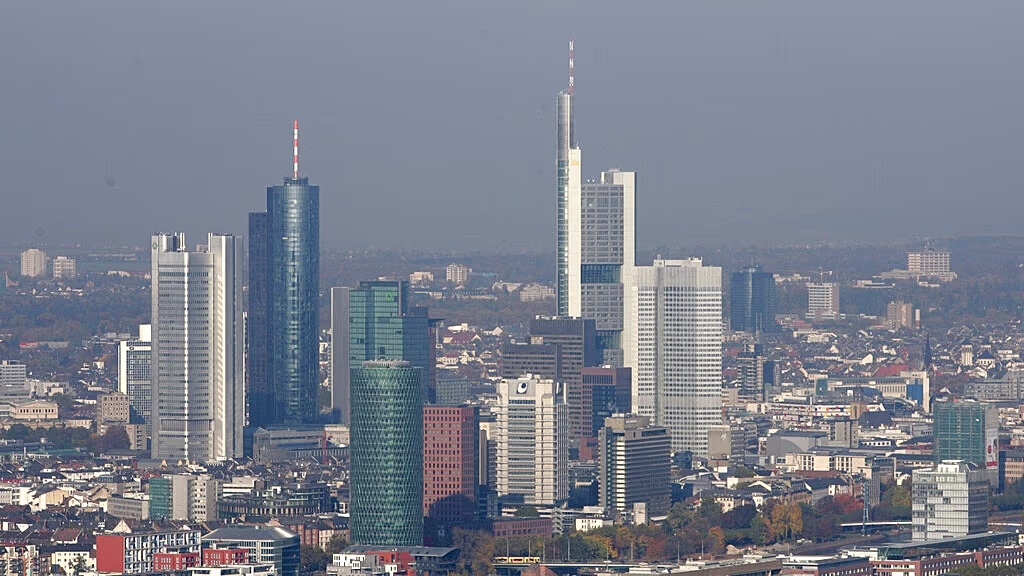
Frankfurt, Germany has been chosen to host the European Union’s new Anti-Money Laundering Authority (AMLA), marking a key milestone in the EU’s efforts to strengthen its fight against illicit finance following a string of high-profile financial scandals.
The German financial hub prevailed over eight rival cities, including Paris, Madrid, and Rome, in a late-night vote held on 22 February. The decision finalises the last outstanding element of the EU’s sweeping anti-money-laundering reform package, which also introduces limits on large cash payments and tighter checks on football agents and sponsors.
Speaking after the vote, Mairead McGuinness of the European Commission said the move was a response to repeated failures in the financial system. She noted that recent scandals had exposed how easily illicit funds could flow through mainstream institutions, adding that the creation of AMLA was a direct answer to those warnings.
The reforms follow major cases such as the admission by Danske Bank that hundreds of billions of euros in suspicious Russian funds were laundered through its Tallinn branch, as well as the collapse of lenders including Malta’s Pilatus Bank and Latvia’s ABLV.
While the EU’s main institutions are concentrated in Brussels, Luxembourg, and Strasbourg, its specialised agencies are spread across member states. Governments generally favour this approach as it distributes economic benefits and decision-making more evenly, although agencies based far from major hubs sometimes struggle to attract staff.
Traditionally, host cities for EU agencies were chosen solely by member states meeting in the Council. Some contests were so close that decisions came down to chance — most famously when the European Medicines Agency was allocated by drawing lots.
That process changed after EU courts ruled that the European Parliament must have an equal say. As a result, both Parliament and the Council were given 27 votes each in the AMLA selection process.
With nine candidates in the running, officials initially doubted the vote would produce a clear winner. Belgian finance minister Vincent Van Peteghem, who currently chairs the Council, said earlier in the week that it remained to be seen whether the process would deliver a decisive outcome.
In practice, however, the Council appeared to coordinate its position in a way that strongly favoured Frankfurt. In the final round of the secret ballot, Frankfurt secured 28 votes, ahead of Madrid with 16, Paris with six, and Rome with four, according to lead lawmaker Eva Maria Poptcheva.
Poptcheva acknowledged that Frankfurt may not have been Parliament’s top choice, noting that Germany did not score highest on certain anti-money-laundering criteria — although she welcomed recent reforms at national level. She described the new joint voting process as not legally binding for the future, but one that “works in practice,” potentially paving the way for similar procedures when siting future EU agencies.
The behind-the-scenes negotiations that secured Germany’s victory remain unclear. Ireland, which had put forward Dublin, may find consolation if its finance minister Paschal Donohoe succeeds in a widely rumoured bid to lead the International Monetary Fund. Other cities in contention included Riga, Vilnius, Vienna, and Brussels.
Beyond politics, practical factors likely played a role. AMLA will directly supervise 40 of the EU’s highest-risk banks, making proximity to major financial institutions a clear advantage.
According to Enrico Aresu of Moody’s Analytics, Frankfurt offers immediate access to a strong financial and supervisory ecosystem. He added that having the European Central Bank based in the same city should make coordination between banking and anti-money-laundering supervisors more efficient.
With Frankfurt now confirmed as its home, AMLA is set to become a central pillar of the EU’s strategy to close loopholes, strengthen oversight, and restore confidence in the bloc’s financial system.