MEPs clash with the EU Commission over anti-money laundering blacklist
- Europe | Published on: 07 Jan 2025
The European Parliament is pushing back against an updated anti-money-laundering (AML) blacklist proposed by the European Commission, which removes several jurisdictions — including the United Arab Emirates, Panama, and Gibraltar — from the EU’s high-risk list.
Members of the European Parliament (MEPs) remain divided with the Commission over which third countries should be classified as having weak regimes for preventing money laundering and terrorist financing. The EU’s blacklist has been out of sync with that of the Financial Action Task Force (FATF) for more than 18 months, a gap that the Commission says is increasingly problematic.
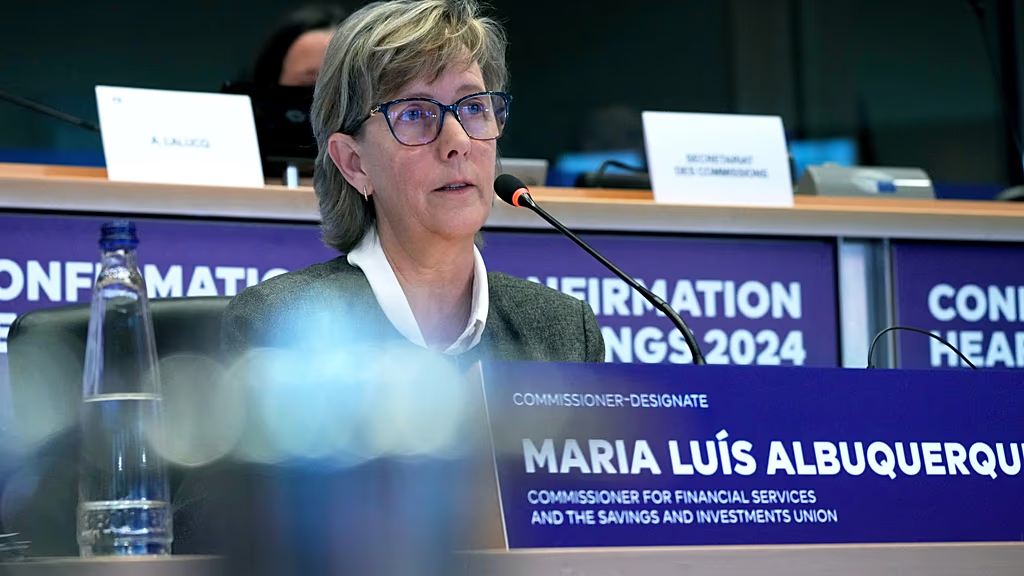
Speaking to lawmakers, EU Commissioner for Financial Services Maria Luís Albuquerque warned that this misalignment has caused “serious friction with international partners.” She argued that ignoring FATF outcomes could weaken the EU’s influence over future technical assessments and reduce its ability to secure meaningful reforms from other jurisdictions.
Earlier this month, the Commission revised its list, adding countries such as Algeria, Angola, Kenya, Monaco, and Venezuela. At the same time, it removed Barbados, Gibraltar, Panama, and the United Arab Emirates. However, the revised blacklist cannot take effect unless it is approved by both the European Parliament and the Council — and so far, MEPs remain unconvinced.
In a resolution passed in April 2024, Parliament rejected the Commission’s decision to delist Gibraltar, Panama, and the UAE. Lawmakers pointed to strong evidence suggesting these jurisdictions have not done enough to prevent — and in some cases may enable — the circumvention of sanctions imposed on Russia following its war against Ukraine.
The resolution warned that such countries could serve as hubs for bypassing EU sanctions, directly or indirectly weakening the Union’s efforts to curb Russia’s war economy.
Addressing MEPs in Brussels — in a sparsely attended session without representatives from groups such as Renew Europe, the European Sovereign Nations (ESN), and The Left — Albuquerque insisted that parliamentary concerns had been taken into account. She maintained that the delisted jurisdictions had demonstrated “concrete and measurable progress.”
Despite this, frustration among lawmakers was evident. Czech MEP Luděk Niedermayer criticised the Commission for failing to engage meaningfully with Parliament, arguing that dialogue had fallen short of what the issue demanded.
Albuquerque also voiced concern about the current stalemate, warning that the EU’s failure to promptly mirror FATF listings leaves its financial system exposed and creates regulatory loopholes. She added that the lack of an updated EU list creates uncertainty for banks and businesses required to apply AML rules.
According to the Commissioner, companies are currently forced to comply with conflicting international and EU lists, increasing compliance costs and harming the EU’s global competitiveness.
The debate grew more confrontational when German Socialist MEP Birgit Sippel accused the Commission of relying too heavily on FATF conclusions. She argued that simply referencing assessments, official visits, and strategic dialogues was insufficient justification for delisting high-risk countries.
Albuquerque rejected the accusation, stating that the blacklist was the result of more than a year of intensive work. She stressed that the Commission’s assessment went beyond FATF reports and included bilateral discussions and on-the-ground evaluations in the countries concerned.
Despite the Commission’s defence, the dispute highlights ongoing tensions between EU institutions over how strictly the bloc should apply anti-money-laundering standards — especially when sanctions enforcement and geopolitical risks are involved.